Welcome to the Opening Day of "Who Cares About Stats?". This issue is dedicated to the Hold. But before the analysis, A quick history of the statistic.
It's 1986: the Mets are iconic, Barry Bonds is a rookie, ~40% of the league is on cocaine (with 11 players suspended by Commissioner Ueberroth over substance abuse), and John Dewall and Mike O'Donnell invent the Hold. They wanted to give a "spot-and-score statistic", that is a stat like SB which doesn't require calculation, to Middle Relievers, but mainly Set-Ups.
Methodology and Definitions
Holds
A hold occurs when a relief pitcher enters the game in a save situation and maintains his team's lead for the next relief pitcher, while recording at least one out. One of two conditions must be met for a hold to be recorded1:
- The pitcher must enter the game with a lead of no more than three runs and maintain that lead while recording at least one out
- The pitcher must enter the game with the tying run on deck, at bat, or on base
Note: A pitcher cannot earn a hold if he finishes the game, earns a save, or is the winning pitcher. Additionally, there are different numbers of holds between BRef and FanGraphs, so the data for this project was all sourced from BRef.
Data Collection
- Exported All 2025 Hold Event Data from BRef
- Imported Data into Excel
- Generated Summary Statistics using VLOOKUP in Excel + PowerBI programming commands
- Quantitative Analysis to perfect Holds+
Statistical Analysis Methods
- Used R and ggPLot2 to form professional visualizations
- Created interactive models using Plotly extension
- Annotated plots for easier interpretation
- Produced three different solutions with suggestions for further development
- Solutions address problems from two fronts: definitionally and relatively/relationally
Programming Environments
- R with Tidyverse
- Python data science stack (pandas, numpy, scikit-learn)
- Jupyter notebooks for reproducible research (Will be added with updates as I learn how to)
- Version control with Git for collaboration
- HTML to build this page
Who Should Care About Holds?
Win Bias in Holds
"The entire way they go about their business is a failure." - Fan Call-In on 1000 AM Chicago ESPN Sports Radio, 20232. The primary issue with the Holds is that a stat that gives value to a player should never entail so much of outside bias to even be possible. Teams with more wins almost always have more Holds and more save opportunities. This trend can be narrowed down smaller to game-level, where when a team deploys a parade of relievers, you get a game like the exhibition match between Israel and Miami. FIVE relievers recorded a Hold for Israel alone. The Marlins, ZERO. The Score? 1-0.
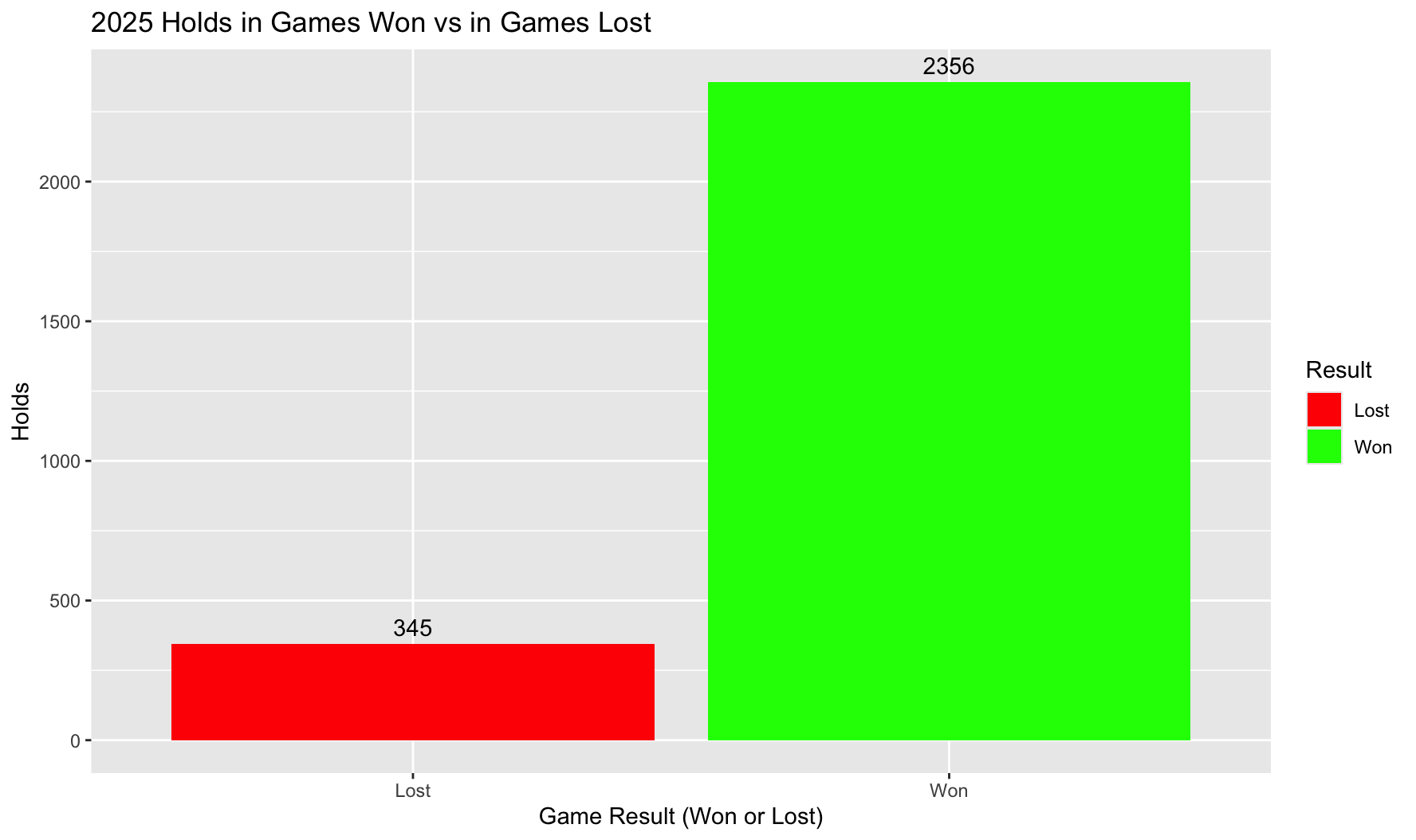
Of the 2701 holds recorded in the 2025 MLB season, only 345 were in games where the team lost. That means Holds in lost games account for only ~12.8% of all Holds recorded. Hold-by-team data shows a similar trend:
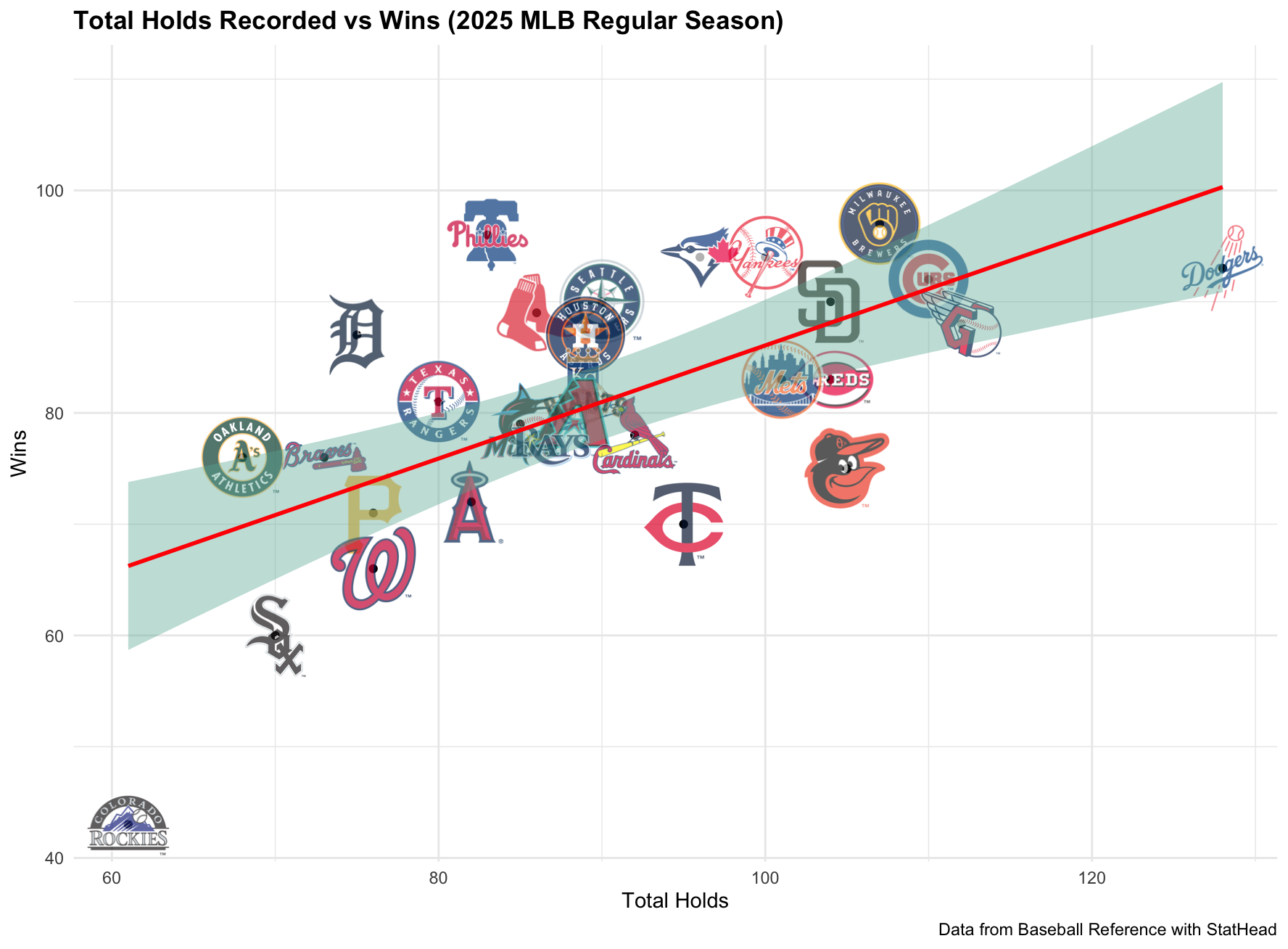
We can construe that, already, Holds are not a good measure of the effectiveness of a reliever, because it is often out of their hands. This is even more inappropriate when it is the sole unique measurement for Set-Ups and MRPs. This same reason is why W/L are such a hot topic for SP. This same trend does NOT apply to closeres regarding saves, because they only come in when their team is ahead or tied. Finally, the original definition of Hold said one cannot be obtained if the same pitcher records either a win, a save, or a game finished. What other decision is missing? Losses. Yes, a pitcher can simultaneously record a Hold and a Loss. This is rare however with it only happening 20 times last season, and no pitcher recording more than one Hold-Loss game in 2025. When Jeff Hoffman gave up four runs, recorded only one out, and dropped his team's win percentage by 47% (No Capital Steez), he stil got the hold.
Solution #1: xHolds
Anybody can hate, and I have given ample evidence against the use of traditional Holds. My first formula worked as follows:
$$ \zeta(s) = \sum_{n=1}^{\infty} \frac{1}{n^s} $$I'm joking, but maybe one day I'll be that good at math. Okay, for real, the formula is...
$$ xHold = \frac{\text{Player Holds}}{\text{Player's Team's Holds} + \text{Player's Team's Save Opportunities}} \times \left[\frac{\text{All Teams' Holds} + \text{All Teams' Save Opportunities}}{30}\right] $$This formula, which is an improved-upon iteration of my original formula, is a minor adjustment which levels the playing field for pitchers on poor-offensive teams. Also, the constant, \(\left[\frac{\text{All Teams' Holds} + \text{All Teams' Save Opportunities}}{30}\right]\) in this formula would change from year to year with 2025's constant being \(153.\overline{6}\)
This constant is the highest number in the last 10 years, which is a testament to the change in bullpen usage and baseball theory.
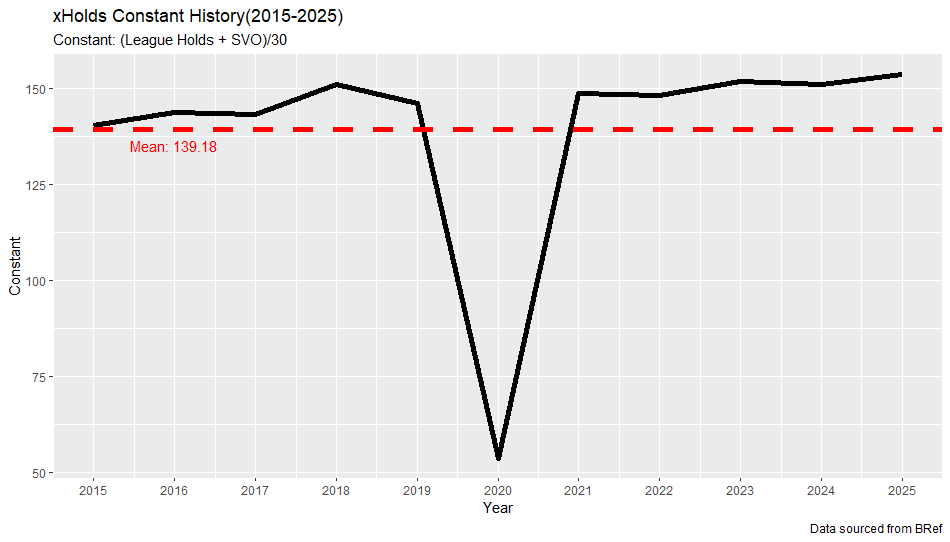 The 2020 season is obviously an exception due to the shortened season, but the general trend is a steady increase in the constant as pitchers, in general, are pulled sooner than before.
Here is how it affects league leaders in Holds:
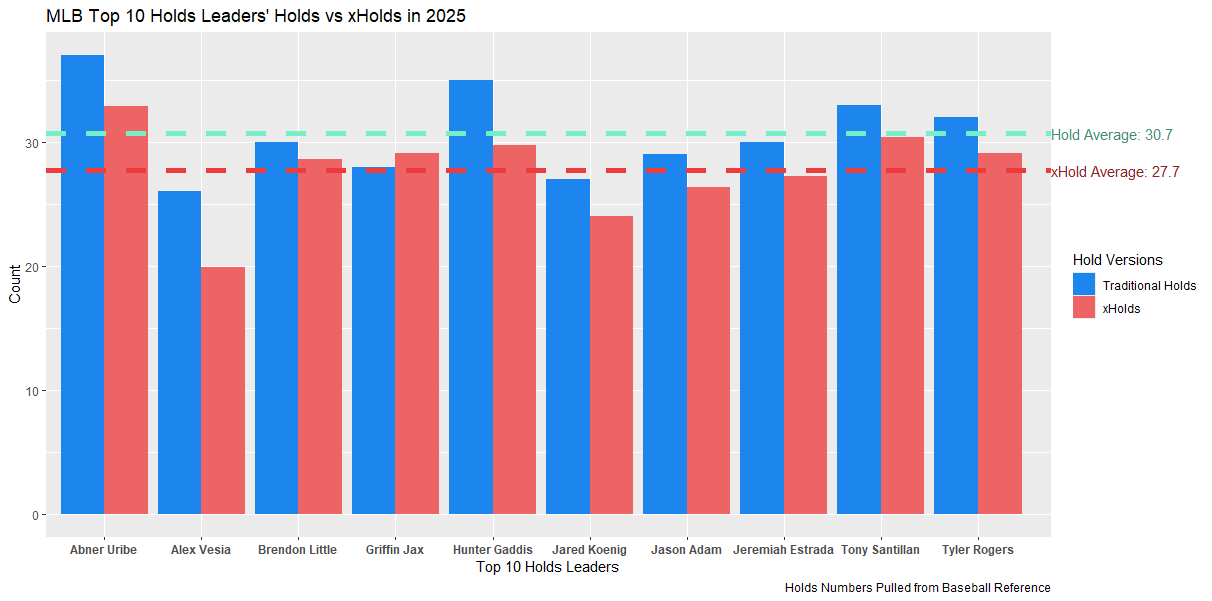
The interactive version of this plot is available HERE
Solution #2: Definitional
If the problem is the not the system but its design, then why change the system and not the design. A better approach would be to redefine what constitutes a Hold, ensuring a more accurate reflection of a reliever's role.
A better working holds definition would be as follows:
- The pitcher must enter the game with a lead of no more than three runs and maintain that lead while recording at least one out
- The pitcher must enter the game with the tying run on deck, at bat, or on base
- The pitcher cannot record a Hold if they are later credited with a win, loss, or save
- The pitcher's WHIP (Walks + Hits per Inning Pitched) must be less than or equal to 1.5 in that outing unless he only pitched one-third of an inning in which case the threshold is 3.0 (This brings the value of holds back to its original intent by McDowell: a SetUp oriented statistic)
- The pitcher's WPA (Win Probability Added) must be positive for that outing (This ensures that the pitcher actually contributed to not only maintaining the lead but also benefiting their team); this will cut down on pitchers who are ineffective and only used in large Run Differential games
Bam! New Definition. This stat could be called Holds And Newer Developments for Offense: HAND (off).
Solution #3: Complementary Hold
Additionally, it would be important to add a complementary statistic to Holds that accounts for effective perormance when the reliever's team is trailing. This would reduce the number of No Decisions where a reliever had a stellar outing that kept his team in reach of a lead change. Going back to the Israel-Miami game, nobody can deny the effectiveness of the Miami relievers, who held Israel to a one run lead after the first pitcher gave up a run. Yet their whole team got No Decisions besides the starter. The formula for this stat would be the same as Holds except the reliever does not enter a save opportunity, but instead keeps his team within 3 runs of the other team, but cannot give up more than 1 run if he is tied, or two runs if trailing one.
Conclusion
Holds are long over do for a change. Along with holds, the solutions provied can be altered to make an xWin statistic. Not to jump ahead but for my next project, I'm planning on creating a weighted RBIs that accounts for all 24 base-out situations to truly find out who is the best at driving in runs. Jonah Hill would be proud. Thank you for tuning into Who Cares About Stats Volume 1 Issue 1: Who Cares About Holds!